Chapter 01 / Mechanism
GHK-Cu Research: How a Copper Tripeptide Modulates 4,000 Human Genes
From fibroblast collagen stimulation to systemic gene-expression resetting — a detailed review of what the peer-reviewed record shows.
GHK-Cu Mechanism of Action
GHK-Cu functions as a copper chaperone — it forms a stable 1:1 Cu(II) complex that concentrates bioavailable copper at wound sites and fibroblast surfaces. Once there, it activates a broad set of cellular repair pathways simultaneously, which is what distinguishes it mechanistically from single-target cosmetic peptides.
The primary documented pathways [4][5]:
TGF-beta and SMAD2/3 signaling. GHK-Cu upregulates TGF-beta receptors and modulates downstream SMAD2/3 signaling to promote collagen and elastin synthesis in wound healing contexts, while suppressing pathological TGF-beta1 elevation in fibrosis models [8].
Nrf2/Keap1 antioxidant defense. GHK-Cu activates the Nrf2 transcription factor, upregulating cytoprotective enzymes including HO-1, NQO1, and superoxide dismutase — reducing oxidative damage to cells and tissues. This pathway mediates GHK-Cu's documented protection against cigarette-smoke-induced emphysema [9].
NF-kappaB anti-inflammatory suppression. GHK-Cu downregulates NF-kappaB pathway activity, reducing pro-inflammatory cytokines TNF-alpha and IL-6 — creating a dual stimulation-and-protection mechanism where matrix proteins are built while their inflammatory degradation is reduced [5].
Wnt/beta-catenin hair follicle activation. This pathway mediates dermal papilla cell activation and anagen phase entry in hair follicle models, explaining the mechanistic basis for GHK-Cu's hair growth activity [7].
SIRT1-dependent metabolic protection. GHK-Cu directly binds and activates SIRT1 (measured binding energy -6.1 kcal/mol), with downstream effects on muscle preservation via the FoxO3a axis, mitochondrial function via PGC-1alpha, and antioxidant defense via Nrf2 deacetylation [10].
MMP/TIMP rebalancing. GHK-Cu corrects the imbalance between matrix metalloproteinases (which degrade collagen) and their tissue inhibitors (TIMPs), preserving matrix integrity in both aging and inflammatory models [18].
VEGF and FGF-2 upregulation. GHK-Cu stimulates vascular endothelial growth factor and fibroblast growth factor-2, supporting angiogenesis in wound beds and hair follicle vascularization [5].
LOXL2 collagen crosslinking support. GHK-Cu activates lysyl oxidase-like 2 (LOXL2), which physically crosslinks collagen and elastin fibers — contributing to the mechanical strength of repaired tissue [5].
GHK-Cu and Gene Expression: The 4,000-Gene Modulation Story
The most striking finding in the GHK-Cu literature is its scale of gene expression influence. Pickart and Margolina (2018) analyzed GHK's gene expression signature in the Broad Institute Connectivity Map dataset and found it modulated approximately 31.2% of human genes — approximately 4,278 genes showing a >=50% expression change, with 59% upregulated and 41% downregulated [4].
Breaking that down by pathway [2][4]:
- Ubiquitin-proteasome system: 41 genes upregulated, 1 downregulated — supporting protein quality control and clearance of damaged proteins
- DNA repair: 47 genes upregulated, 5 downregulated
- Antioxidant defense: 14 genes upregulated, 2 prooxidant genes downregulated
- Nervous system function: 408 neuron-related genes upregulated vs 230 downregulated [14]
- Fibrinogen beta chain (FGB): -475% expression change (strongly downregulated) — relevant to coagulation and inflammatory signaling
Pickart and Vasquez-Soltero (2014) described GHK as "resetting the human genome to health" [2]. This is a large claim and carries the appropriate caveat: the analysis uses gene expression database signatures, not direct dose-response experiments in human subjects. The Connectivity Map analysis identifies pattern correlations; it does not establish causal efficacy at specific doses or tissue targets.
The GHK-Cu gene expression modulation data is the strongest mechanistic argument for the compound's broad tissue effects — and also the claim most in need of independent replication.
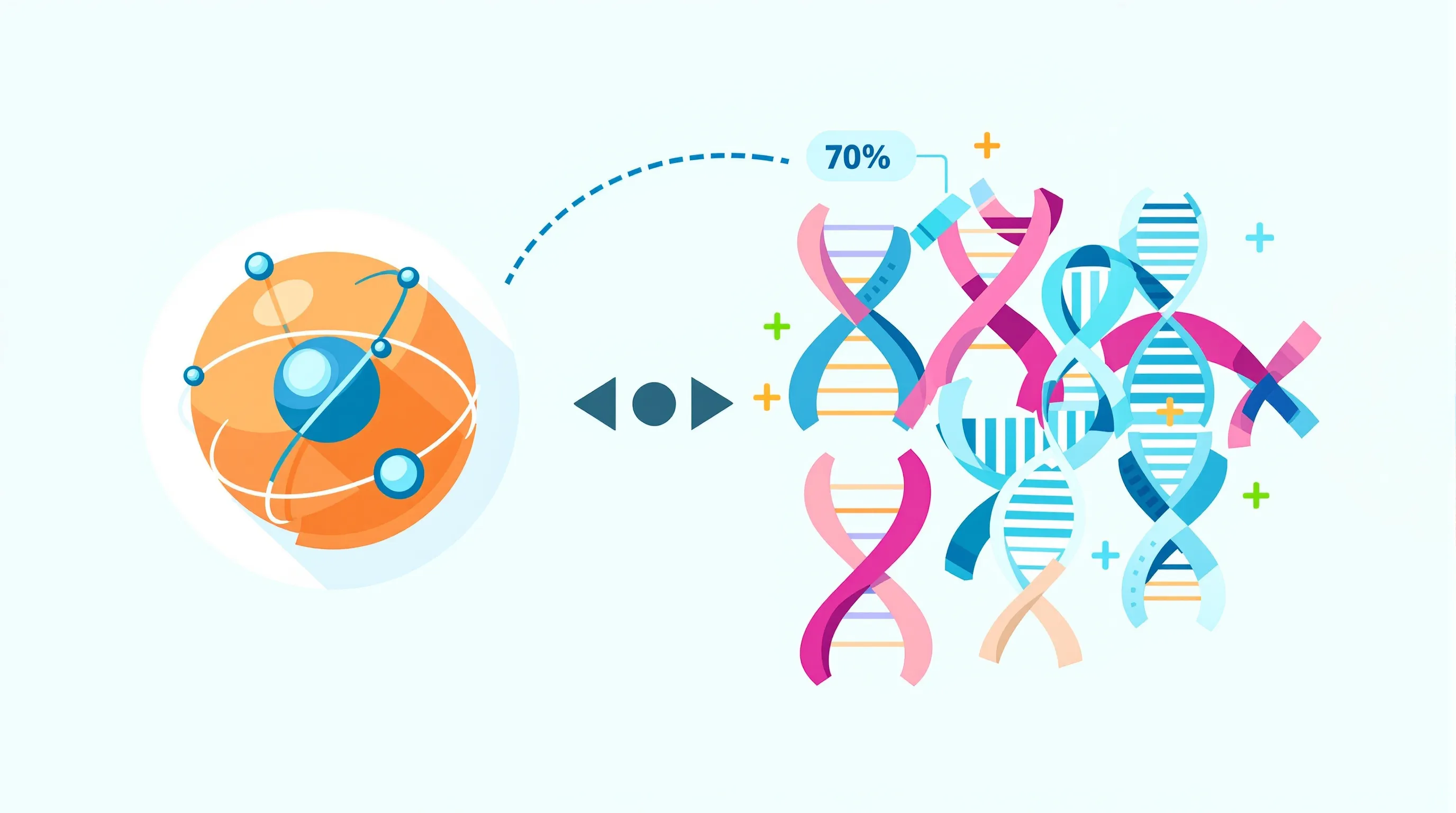
GHK-Cu Mechanism: Collagen and Elastin Upregulation
The collagen stimulation finding was the first and remains the best-characterized effect in the GHK-Cu literature. Maquart et al. (1988) demonstrated that GHK-Cu stimulated collagen synthesis in human dermal fibroblast cultures at picomolar to nanomolar concentrations — stimulation began between 10^-12 and 10^-11 M, maximized at 10^-9 M, and was independent of changes in cell number [1]. That last point is mechanistically important: the effect is a specific metabolic upregulation of protein synthesis, not a consequence of proliferation.
The molecular mechanism involves two arms operating in parallel. The stimulatory arm runs through TGF-beta receptor upregulation and SMAD2/3 signaling, which drives transcription of collagen types I, III, and IV and activates LOXL2 for crosslinking [5]. The protective arm runs through MMP/TIMP rebalancing: GHK-Cu increases TIMP expression while reducing the collagenase activity of MMP-1 and MMP-2, so less collagen is degraded even as synthesis increases [18].
Elastin upregulation follows a similar dual mechanism. GHK-Cu stimulates elastin gene transcription and LOXL2-mediated elastin crosslinking while suppressing elastolytic MMPs [5]. The net effect in human dermal fibroblast cultures and skin models is an improvement in both structural protein content and matrix organization — which translates to measurable improvements in skin firmness and wrinkle depth in topical human studies [18].
A 2023 study showed that combining GHK-Cu with low-molecular-weight hyaluronic acid in a 1:9 ratio elevated collagen IV synthesis 25.4-fold in human dermal fibroblast cultures and 2.03-fold in ex-vivo skin models — suggesting the two compounds have synergistic effects on the dermal-epidermal junction [12].
Recent GHK-Cu Research: 2023–2025
The past two years have extended GHK-Cu's documented activity into new tissue systems.
Gut epithelium (2025). Mao et al. (2025) showed GHK-Cu protected against DSS-induced colitis in mice via SIRT1/STAT3 signaling — reducing TNF-alpha, IL-6, and IL-1beta, restoring tight junction proteins ZO-1 and Occludin, and suppressing Th17 differentiation [16]. This extends GHK-Cu's tissue-repair role to the intestinal epithelium, following earlier work in lung and skin.
Skeletal muscle (2023). GHK-Cu rescued cigarette-smoke-induced skeletal muscle dysfunction in mice via SIRT1 activation (measured binding energy -6.1 kcal/mol) at doses of 0.2 and 2 mg/kg IP, with dose-dependent improvements in muscle mass and cross-sectional area [10].
Age-related fibrosis (2024). GHK reversed the aged fibroblast phenotype in 24-month-old mice — reducing senescence markers, restoring migration capacity, and converting pathological myofibroblast persistence to physiological resolution via integrin-beta1 signaling [11].
Skin permeation science (2025). A systematic review (Ogorek et al., 2025) identified the validated skin permeation measurement of liposomal GHK-Cu as the critical unresolved research gap. Free GHK-Cu penetrates the stratum corneum at only 0.6–2.8% copper retention; novel delivery systems (ionic liquid microemulsions) can achieve approximately 3-fold improvement, enabling anagen entry in mouse hair follicles within 6 days [7][19].