Chapter 04 / Dosage & Chemistry
GHK-Cu Dosage in Published Research: Routes, Concentrations, and Copper Chemistry
What the peer-reviewed record documents — topical concentrations, animal model doses, reconstitution science, and the open questions in human pharmacokinetics.
GHK-Cu Dosage in Published Research
GHK-Cu is a research peptide compound without an FDA-approved drug indication for any route of administration. No validated human systemic dosing protocol exists in the peer-reviewed literature. What follows is a summary of the doses used in published studies, organized by species and route — not a dosing recommendation.
Human topical studies. Topical GHK-Cu concentrations in published human cosmetic and dermatological studies range from 0.1% to 3%. The Badenhorst (2016) nanocarrier wrinkle study did not fully disclose concentration; the ALAVAX hair trial used 50–100 mg/mL of the GHK peptide complex [6][18].
Human clinical pharmacokinetics. No formal Phase I human pharmacokinetic study for systemic GHK-Cu has been registered on ClinicalTrials.gov or published in peer-reviewed literature. The plasma half-life after intravenous administration is estimated at approximately 0.5–1 hour based on rapid peptidase degradation kinetics in plasma — an estimate from analogy, not direct measurement. Subcutaneous injection would produce slower absorption with a functional activity window of several hours at local tissue sites.
Animal intraperitoneal studies. The lung protection studies used GHK-Cu at 0.2, 2, and 20 μg/g/day IP in C57BL/6J mice [9]. The pulmonary fibrosis studies used 2.6, 26, and 260 μg/mL/day IP on alternating days from day 4 to day 21 [8]. The skeletal muscle studies used 0.2 and 2 mg/kg IP in mice [10].
Animal intranasal studies. The aging-mouse cognitive study used GHK-Cu at 15 mg/kg/day intranasal for 8 weeks in 20-month-old mice [15].
In-vitro cell studies. Fibroblast collagen stimulation was measured from 10^-12 M to 10^-9 M in cell culture medium [1].
GHK-Cu Dosing Ranges in Animal and Human Studies
A consolidated reference by study type:
| Species | Route | Dose Range | Study Focus |
|---|---|---|---|
| Human fibroblasts (in vitro) | Cell culture | 10^-12 – 10^-9 M | Collagen synthesis [1] |
| Human skin (ex vivo) | Topical | 0.1–3% in formulation | Penetration, collagen [13][18] |
| Human (RCT, topical) | Topical | 50–100 mg/mL (ALAVAX complex) | Hair growth [6] |
| Mouse C57BL/6J (IP) | Intraperitoneal | 0.2, 2, 20 μg/g/day | Lung protection [9] |
| Mouse C57BL/6 (IP) | Intraperitoneal | 2.6, 26, 260 μg/mL/day | Pulmonary fibrosis [8] |
| Mouse (IP) | Intraperitoneal | 0.2, 2 mg/kg | Skeletal muscle [10] |
| Mouse aging (intranasal) | Intranasal | 15 mg/kg/day for 8 wk | Cognitive aging [15] |
| Mouse (topical microemulsion) | Topical | CaT-ME formulation | Hair follicle [7] |
The dose ranges are not directly comparable across routes, species, and tissue targets. No dose-conversion factor from animal IP doses to human topical concentrations is established in the literature.
GHK-Cu Half-Life and Pharmacokinetics
Formal published pharmacokinetic data for GHK-Cu after IV or subcutaneous administration in humans does not exist. The following is based on available indirect evidence.
The parent tripeptide GHK is subject to rapid hydrolysis by plasma peptidases — proline endopeptidase, aminopeptidases, and non-specific endopeptidases all cleave small tripeptides in plasma within minutes to hours. Based on this peptide degradation kinetics, the plasma half-life after IV administration is estimated at approximately 0.5–1 hour.
Copper chelation by GHK alters the peptide's stability relative to the free form: the coordination bond to Cu(II) via the histidine imidazole nitrogen makes the peptide more resistant to peptidase activity at physiological pH. Whether this extends the functional half-life significantly in plasma or tissue is not established in the published record.
Topical pharmacokinetics are better characterized. In-vitro human skin permeation data shows the stratum corneum accumulating 438-fold over baseline copper levels and the epidermis 165-fold over 48 hours, with approximately 2% total penetration through to the dermis [13]. A tissue depot forms in the stratum corneum that may provide a sustained slow-release effect over hours to days. Novel delivery systems (ionic liquid microemulsions) achieve approximately 3-fold improvement in transdermal delivery [7][19].
GHK-Cu Dosing in Published Research Protocols
Published research protocols for GHK-Cu vary substantially by route and endpoint. Key parameters documented in the literature:
Topical formulation concentration. The most common range for published human and ex-vivo skin studies is 0.1–3% GHK-Cu by weight in the final formulation. Lower concentrations (0.1–0.5%) appear in longer-duration stability-focused studies; higher concentrations (1–3%) in short-duration efficacy assessments [13][18].
pH stability window. Optimal formulation pH is 5.0–6.5. Below pH 3.5, strong reducing agents (including ascorbic acid / Vitamin C) reduce Cu(II) to Cu(I), destroying the active coordination complex [22]. Most published formulations use a buffer in the pH 5.5–7.0 range.
Injectable research doses. Injectable GHK-Cu research in animal models uses doses in the 0.2–260 μg/g/day range depending on species and endpoint. No peer-reviewed human pharmacokinetic dosing protocol has been published. The injectable compound community reports doses typically in the 1–5 mg range, but these are not supported by peer-reviewed human PK data.
Study duration. Topical collagen studies: 4–12 weeks. Hair follicle human RCT: 6 months. Rodent IP protection studies: 17 days to 8 weeks. No published long-term (>12 month) human safety study for any route.
Why GHK-Cu Solution Appears Blue: The Chemistry Explained
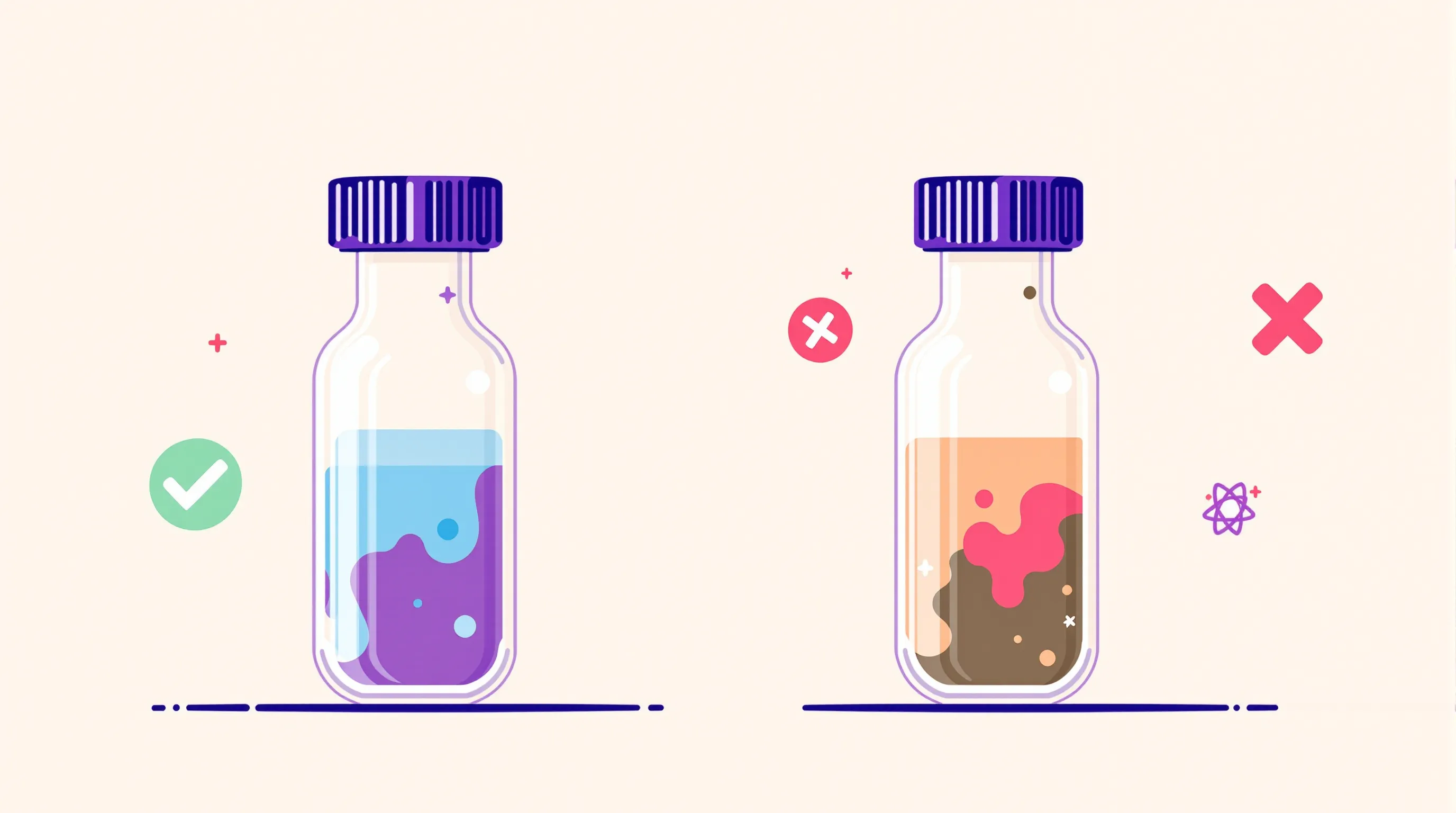
Reconstituted GHK-Cu solution is blue-violet in color. This is expected and indicates the compound is intact.
The color arises from the Cu(II) d-orbital electronic absorption — a characteristic absorption band in the 500–600 nm range (appearing blue-violet to the human eye) that is present whenever copper(II) is in the stable chelation geometry of the GHK-Cu complex [22]. The blue-violet color is the compound working as intended.
A color shift after reconstitution indicates a problem:
Green or brown. Indicates Cu(II) oxidation to Cu(III) or precipitation of copper as hydroxide or oxide. The peptide-copper coordination bond has broken and the compound has degraded — the active chelated form studied in the literature is no longer present [22].
Yellow or colorless. Could indicate very high dilution, incorrect reconstitution (wrong solvent, wrong pH), or loss of copper during storage. Not the expected appearance of correctly reconstituted GHK-Cu.
Practical stability notes from the research literature [22]: optimal storage of lyophilized GHK-Cu is at -20°C, protected from moisture and light — stable for 12–24 months. Reconstituted solution should be stored at 4°C and used within 2–4 weeks to minimize oxidation.
For GHK-Cu dosage in published studies, the chemistry of the copper complex is fundamental to understanding why formulation conditions matter for the compound's activity.
Reconstituted GHK-Cu Color Changes: Oxidation and Stability
Brown or green coloration after reconstitution indicates copper oxidation from Cu(II) to Cu(III) or precipitation. This means the copper-peptide coordination bond has broken and the compound is no longer the active chelated form documented in the research literature [22].
The oxidation pathway: Cu(II) in the GHK-Cu complex is reduced to Cu(I) by strong reducing agents (ascorbic acid at pH <3.5 is the most common cause) or to Cu(III) by oxidative conditions. Both oxidation states break the specific coordination geometry responsible for the compound's biological activity.
Ascorbic acid incompatibility is a formulation chemistry issue with direct practical relevance: Vitamin C serum at pH 2.5–3.5 will reduce Cu(II) to Cu(I) and destroy both the copper peptide and the ascorbic acid simultaneously [22]. Research formulation protocols use separate application windows — copper peptide and Vitamin C are not combined in the same vehicle.
Reconstituted GHK-Cu Solution Stability and Storage: the research literature recommends 4°C storage and use within 2–4 weeks after reconstitution to minimize oxidation [22]. Lyophilized peptide stored at -20°C is stable for 12–24 months when protected from moisture and light.